£4.70 – £7.06Price range: £4.70 through £7.06
Salix elaeagnos ‘Angustifolia’, the Rosemary Willow, showcases elegant silvery-green foliage. This hardy, versatile shrub adds beautiful texture to UK gardens, while its early catkins provide vital food for pollinators.
400 in stock
Discover Salix elaeagnos ‘Angustifolia’, the Rosemary Willow, with elegant, narrow, silvery-green leaves, perfect for UK gardens.
Also known as Rosemary Willow or Olive Willow, this distinguished shrub brings an air of sophistication. It thrives in various garden settings, easily adapting to conditions across the British Isles. Its delicate appearance belies a robust nature, making it a favoured choice for many gardeners. Originating from central and southern Europe, this cultivar is valued for its refined foliage, adding year-round appeal.
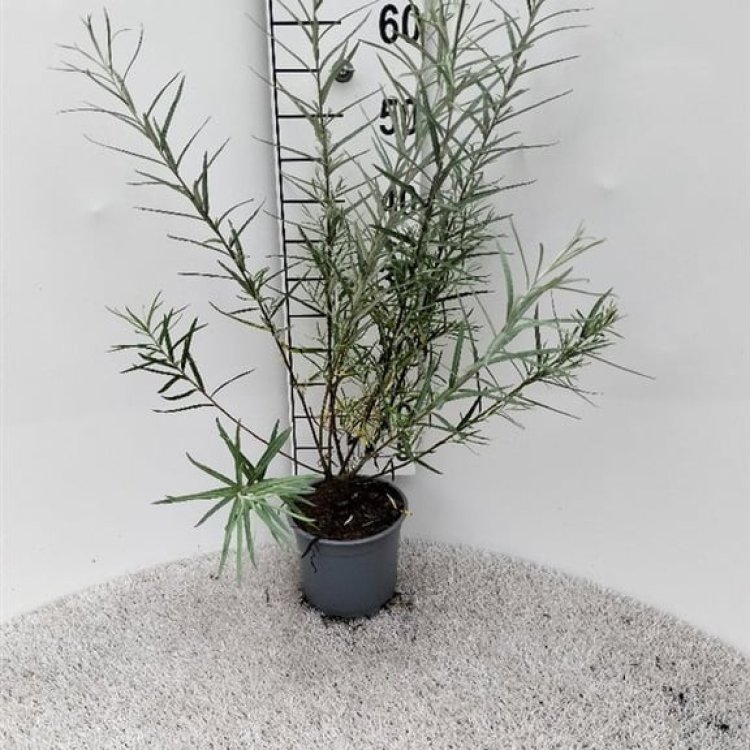
The most captivating feature of Salix elaeagnos ‘Angustifolia’ is its distinctive foliage. Each slender leaf is a captivating silvery-grey-green. It provides a soft, luminous quality in the garden. The underside boasts a rich, silvery indumentum, reflecting light beautifully. These linear leaves closely resemble those of rosemary, giving rise to its common name, Rosemary Willow.
This deciduous shrub develops a graceful, upright habit. It forms a dense, multi-stemmed bush. As it matures, it creates an elegant focal point. It adds fine texture to any planting scheme. Its dense growth offers year-round interest.
While its foliage is the main attraction, Salix elaeagnos ‘Angustifolia’ also presents subtle charms. In late winter or early spring, usually around February to March in the UK, it produces small, yellow-green catkins. These develop along its stems before new leaves emerge.
Importantly, these early catkins are a vital source of nectar and pollen. They nourish foraging bees and other early pollinators. Therefore, planting this willow greatly assists local wildlife. It provides food when other sources are scarce. Furthermore, its dense branching offers shelter for small birds. This enhances biodiversity in your garden.
This Rosemary Willow is incredibly versatile in the garden. Its elegant form makes it a superb choice as a specimen plant. You can also use it to create an informal hedge or screen. It works well at the back of mixed borders, providing a soft, silvery backdrop.
Salix elaeagnos ‘Angustifolia’ tolerates various soil conditions. Yet, it flourishes best in moist, well-drained sites. Although it can grow quite large, it responds well to pruning. Pruning in late winter encourages a bushier habit. This rejuvenates the silvery foliage. It also helps maintain a tidy shape. Consider its potential size when choosing a planting spot.
The genus name ‘Salix’ is the classical Latin term for willow. The species epithet ‘elaeagnos’ references the plant’s resemblance to the Oleaster genus, Elaeagnus, notably its distinctive silvery leaves. The cultivar name, ‘Angustifolia’, is Latin for ‘narrow-leaved’. This perfectly describes the plant’s characteristic slender foliage, thus encapsulating its key botanical features.
Very hardy. Tolerates temperatures typical of a continental winter.
Keep the soil consistently moist, especially during dry spells and in the plant's initial year of establishment. Salix elaeagnos 'Angustifolia' thrives in full sun to partial sun. It prefers moist, well-drained soil but is adaptable to a wide range of soil types, including clay and chalk. Prune this willow in late winter or early spring to maintain its desired shape and size, and to encourage fresh, silvery new growth. Hard pruning, or coppicing, can be carried out every few years to rejuvenate the plant.
This plant is deciduous so it will lose all of its leaves in the autumn and get fresh new foliage each spring.